By Amanda Crawford
Sitting in Jennifer Paton’s living room of her one bedroom first floor flat she looks like a normal healthy young single woman, with funky hair, piercings, tattoos. She is bubbly and what seems a confident person.
She offers me a cup of tea with a big cheeky smile; projecting her voice around the room as she introduces me to her two cats. “Ralph and Indie, they are harmless but Ralph doesn’t really like people so he might hide,” she giggles.
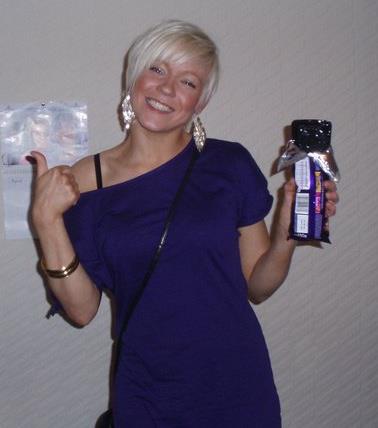
Jennifer is known to her friends and family to have a big personality and a lust for life, but there is a different side to her, that some may not know.
The 24-year-old has been diagnosed with a condition called Hypermobility Syndrome (HMS) which affects joints, muscles and ligaments. Commonly known as “double-jointed” HMS is genetic and affects people on a wide scale, many people are hypermobile and live a normal life without it affecting them. However, when there is chronic pain it becomes a “syndrome” and other complications can occur.
HMS is thought to be largely under diagnosed, with 50 per cent of known patients waiting over ten years for diagnosis, according to the British Health Association in 2013.
HMS is a condition that, if on the higher end of the spectrum, can cause the patient various health problems, chronic pain and/or operations to rebuild muscle and bone around the joints.
Although Jennifer can’t remember when she discovered her “bendiness”, she grew up boasting that she could do the splits naturally and click her joints such as her hip or shoulder joints out of place.
She says proudly, “My party trick was ‘oh look at what I can do with my hip’. I always knew I was a bendy child. I could bring my leg up over my head. It wasn’t until I was much older, and I began to experience pain, I realised something was wrong.
“I remember my mum always telling me off, telling me ‘not to do that’ when I’d pop a hip or a shoulder blade. She would say, ‘you really need to stop doing that you are going to do damage to yourself.’ I never understood why I had to stop though.”
Although Jennifer is one of few people diagnosed in early stages of the condition, she has paid a price for the misunderstanding of HMS within the medical profession and has endured gruelling surgeries on her joints already.
It is well known by experts that surgery is a last resort treatment for this condition.
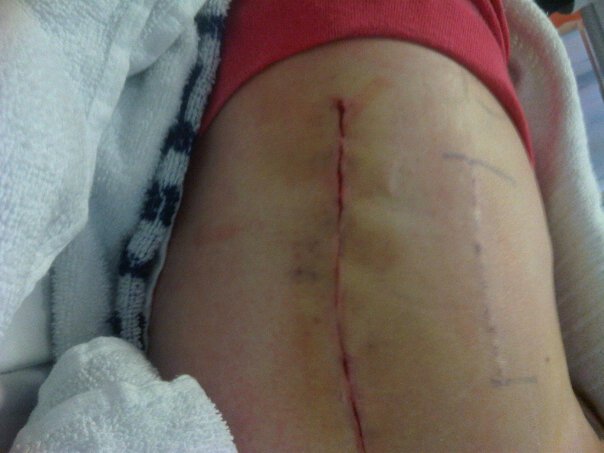
The implications, entailed by the surgery, were to be discovered by Jennifer when her emotional health suffered too. She has found it difficult to come to terms with lifestyle changes, missing out on work and living with the physical scars her operations have left her with.
“I feel like the only reason I got my first surgery was to shut me up. As though the doctors were saying ‘get off our backs.’ My first operation in December 2009 was on my hip and initially they were going to do keyhole surgery. When I was on the table, they realised they had to go in further, so I woke up to a huge scar from my hip to my leg. It didn’t work.
“I then went for osteochondroplasty in November 2011, which is basically a rebuild of the hip. That was hard. I was in hospital for a week then came home and all that I could do was bed rest. I had to get washed over the sink with a cloth a cushion for my couch. I had to sit at a certain height. I had a table which was like a zimmer-frame and a toilet aid which looked like a spaceship over my toilet.”
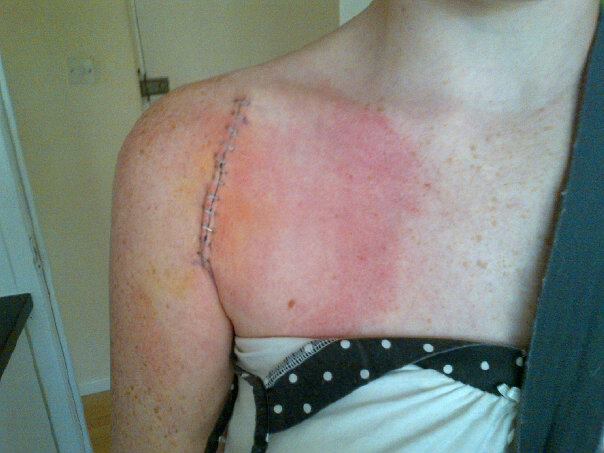
Jennifer has had four operations; three on her hip and one on her shoulder. In 2012 she has had two major operations on her hip and most recently on her shoulder just three weeks ago. She now has a long scar on her shoulder. She found out in November, after a meeting with her surgeon, that that surgery also did not work to fuse and stabilise the joint.
She has found it difficult to juggle important tasks such as going to physiotherapy, meetings with occupational therapists and hospital appointments along with her daily needs; remembering her exercises, medication, which way to sit up and which way to sit down.
Jennifer’s voice lowers and softens. She puts aside her bubbly, cheeky way while she reminisces about her most difficult surgery. “After my hip operation last year I was trying to remember to do a million things, take my meds at this time and that time, phone work, go for meetings, go to physio therapy and so on. I couldn’t get into bed without going through rigmarole. It was an inconvenience. It was tiring and emotionally draining. I had a litter picker to save me from bending down to pick things up off the floor. I had an extremely, over-exaggerated shoehorn to put socks and shoes on. It was horrible.”
There are not two patient cases which are the same, because of the spectrum of hypermobility; it is a unique condition. Jennifer has faced tough decisions due to HMS; however, she still firmly believes there are people who are “worse off” than her. She says modestly, “I am perfectly healthy compared to some people I have seen. I am lucky that I can still go on nights out. I can still walk. I am fortunate in that way.”

Jennifer empathises, “I know how it feels to be poked and prodded by helath professionals and it gets to a point you just want to scream leave me alone, I don’t want to go for more tests I don’t want to give more bloods I don’t want to go for another MRI; they are scary they are horrible. It’s almost as if it is unnecessary stress and anxiety, because nothing ever comes out of it. To think that there are people worse off than me, who maybe don’t have the mental capacity to understand it or young kids. It’s sad.”
She doesn’t think that there is enough support for people with her condition and believes there is a misconception within society brought on by general lack of HMS knowledge, and with only one relevant support network to Jennifer’s condition this is not surprising.
Hypermobility Syndrome Association is a charity dedicated to researching and providing information on HMS. Jennifer had never heard of HMSA until I informed her just two days before she shared I interviewed her.

A spokesperson from HMSA said. “Unfortunately there are no current statistics to say how many people suffer the condition, as there is very little research and that is what we are trying to change.”
Jennifer lives life to as full as her body will allow if not, sometimes more. She has enjoyed jumping off Loch Lomond pier with friends, holiday’s, nights out in her crutches and prides herself as the “life and soul of the party.”
Jennifer admits that she doesn’t get an opportunity to be “down in the dumps” for too long because there are too many people around her who won’t let her.
Tearfully Jennifer says, “It’s amazing to know that my friends care that much that if I need them they are there for me. It is nice be loved like that. My friend Beth kicked my arse big time after the big hip operation last year. She came over and told me I was going out and she helped me to get up and ready. Without her to take control that day, I could have ended up in a very dark place.”
Beth Eadie, a mother-of-two described her closest friend, “Jen is fun and energetic, yet she is a caring and understanding person. When Jen is leading up to surgery she becomes agitated and short-tempered. Surgery and her scars are a huge deal to Jen. In all honesty I think that she copes amazingly.”
Although Jennifer faces more physiotherapy and months off work she remains strong. “I don’t want to be the person who thinks I wish I’d done that. I want to know that when I am old I can tell stories and tell people that I lived a brilliant life. I want to embrace it. I don’t want to miss a beat.”
 Amanda Crawford - Portfolio
Leave a comment